Blog

Bitcoin vs Traditional Investments: Which Asset Is More Resilient During Economic Uncertainty?

Bitcoin is a digitally scarce asset that trades 24/7, unlike stocks, bonds, or real estate, which depend on financial institutions, market hours, and policy-driven supply.

When markets are uncertain, every investor begins to ask the same question: “where should my money really be?” For a long time, traditional investments like stocks, bonds, and real estate have been seen as the foundation of stability.

But the rise of Bitcoin has introduced a new kind of asset – one that doesn’t follow the same rules, doesn’t rely on institutions, and operates in a completely digital, always-on economy.

But is Bitcoin actually resilient when economies and markets go uncertain – or does it crash more than the markets it claims to outperform? 

In this blog, we’ll break down what truly defines resilience in uncertain economies and compare how Bitcoin and traditional assets perform when it matters the most.

What makes an investment resilient during economic uncertainty?

A resilient investment is one that acts as a hedge against inflation, stays liquid during financial crises, recovers quickly after market downturns, and moves independently of overall market shocks. The most resilient assets are the ones which score well amongst these five dimensions: inflation protection, crisis liquidity, volatility profile, market correlation, and long-term return potential.

Key characteristics of a resilient investment

  • Inflation protection: Maintaining purchasing power when currency value erodes.
  • Correlation to stocks/bonds: Moves independently of bonds or stocks  during financial shocks.
  • Liquidity during crisis: Can be easily sold or bought when markets are uncertain.
  • Volatility profile: Some volatility is acceptable if complemented with strong long-term return.
  • Long-term return potential: Resilient investments should not only protect wealth but grow it over time.


Bitcoin vs traditional investments: performance overview

Bitcoin has delivered some of the highest long-term returns among all major investments, but with higher volatility compared to stocks, bonds, and real estate. In 2025 specifically, equities posted gains while Bitcoin experienced swings – highlighting that Bitcoin behaves more like a high-growth macro asset.  Coingeko 

Bitcoin vs Stocks: return comparison (2024–2026)

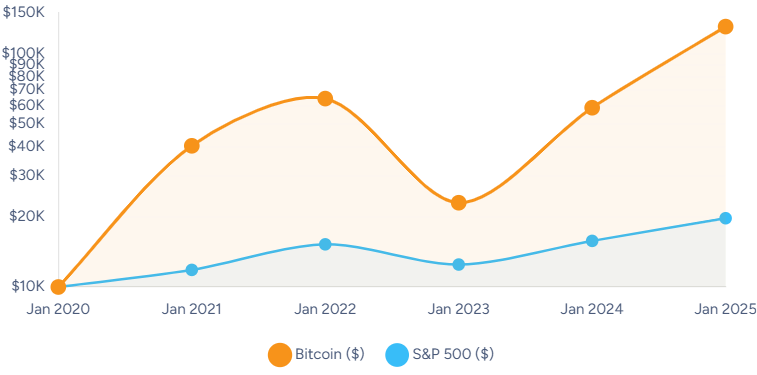
When it comes to raw return potential, Bitcoin is a major asset class — but the comparison with stocks over 2024–2026 reveals it can be volatile as well. In 2024, Bitcoin surged +121.05%, shattering the S&P stock’s already impressive +25.02% total return – a gap of nearly 5× in a single calendar year. It continued till $108,000 in December 2024. (Visual Capitalist, Jan 2026).

In the 2025–2026 period, equities remained comparatively stable, but Bitcoin experienced swings. It declined during parts of 2025 and fell 20% from its late-2025 peak into early 2026, illustrating how crypto cycles can diverge. Financial Times 

Growth of $10,000: Bitcoin vs Stock (2020–2025)  Sources: CoinGecko Historical Bitcoin Price Data (Jan 2025) | S&P Global Market Intelligence Annual Returns (Jan 2025)
Bitcoin vs Bonds: inflation protection analysis

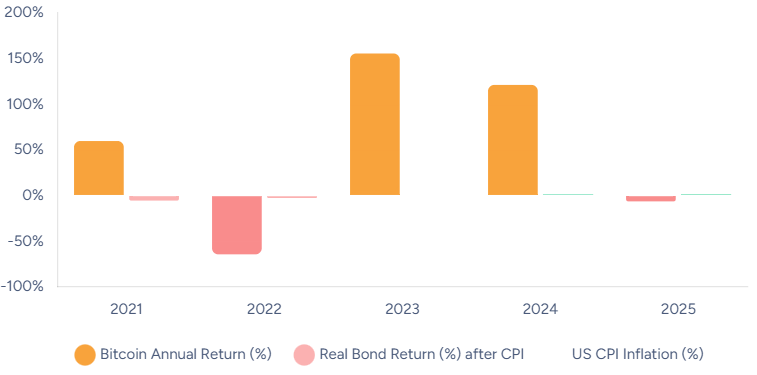
In 2024, the US 10-year Treasury Bond had approximately yielded  4.2 — 4.3% annually –  a nominal return, but it was eradicated once US inflation hit. Meanwhile, Bitcoin’s return was +121.05% and its hard-coded supply cap of 21 million coins — combined with the April 2024 halving event, created an algorithmically scarce asset that no bond can replicate.

Bitcoin’s return profile contrasts sharply with this stability. It highlights that Bitcoin exhibits “heavy-tailed” return distributions—meaning extreme gains and losses occur far more frequently than in equity benchmarks. Arxiv

Bitcoin vs Bonds: inflation protection analysisBitcoin Return vs Bond Yield vs CPI Inflation (2021–2025) Sources: Bitcoin Annual Returns — Slickcharts.com (Feb 2026) |
Bitcoin vs Real Estate: liquidity and growth comparison

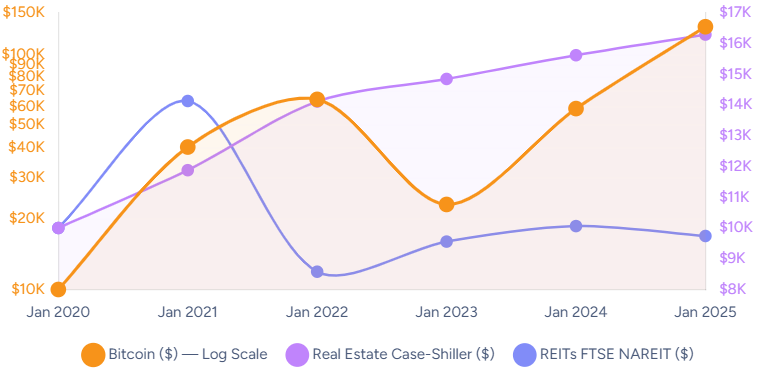
Real estate approximately yielded  4.3 — 5.3% in 2024, but it declined due to  persistently high mortgage rates for most of the year (Case-Shiller Q4 2024, Feb 2025). REITs (Real Estate Investment Trusts), the most liquid proxy for real estate returns, actually struggled throughout 2025 as elevated interest rates kept borrowing costs high.

On a pure return basis, Bitcoin investments outperformed real estate in 4 out of the last 5 years — 2021, 2023, 2024 comprehensively, and even 2022 saw Bitcoin’s -64% drawdown paired against real estate’s modest appreciation of ~10%, which erased quickly in 2023. 

Bitcoin vs Real Estate: liquidity and growth comparison Cumulative Growth of $10,000: Bitcoin vs Real Estate vs REITs (2020–2025)Sources: CoinGecko Historical BTC Price Data (Jan 2025)

Key findings

  • Bitcoin has emerged as a macroeconomic asset: It highlights global liquidity cycles, monetary policy shifts, and inflation expectations just rather than isolated crypto-market trends.
  • Return potential has constantly outpaced traditional investments over longer durations: While stocks, bonds, and real estate delivered steady performance, Bitcoin demonstrated the ability to capture major gains during diversifying economic phases.
  • Unlike bonds, Bitcoin is supply-driven: Its fixed issuance supply makes it behave more like a scarce digital commodity, positioning it as a hedge against currency debasement rather than an income instrument.
  • Compared to real estate, Bitcoin offers mobility and instant liquidity: Property markets adjust slowly and are tied to credit conditions, while Bitcoin can reprice globally in real time, which is why many investors evaluating bitcoin vs traditional investments consider its liquidity unique.
  • The key distinction is function: Traditional investments are made to preserve and compound wealth slowly and gradually, while Bitcoin is created to capture monetary shifts and technological adoption cycles at a global scale.

Bitcoin vs traditional investments: key differences at a glance

In direct comparison across metrics, traditional investments highlights preservation, income, and gradual compounding, whilst Bitcoin highlights scarcity, programmability, and real-time global liquidity.

MetricBitcoinStocksBondsReal Estate
Inflation ProtectionFixed supply makes it naturally scarce, aiding in preserving value in inflationary conditions and monetary expansion cycles.Can possibly outpace inflation in gradual time, but returns depend on corporate earnings and economic growth.Most vulnerable to inflation because returns are fixed and purchasing power can erode.Partial hedge, but tied to local markets, interest rates, and financing costs.
Crisis LiquidityCan be traded all the time 24/7 globally and can be moved instantly without intermediaries. Use Speed Wallet to send & receive Bitcoin instantly.Market-hour dependent and subjected to exchange halts or limitations during crises.Liquid in theory, but pricing and access depend on institutional markets.Highly illiquid; selling property takes time, legal processing, and transaction costs.
Volatility ProfileHigher volatility, but this enables rapid repricing and strong upside during macro shifts.Moderate volatility tied to earnings cycles and investor sentiment.Low volatility but limited growth potential.Slow-moving; values adjust gradually rather than dynamically.
Market CorrelationIncreasingly viewed as a macro asset with unique behavior that can diversify portfolios beyond traditional investments.Closely linked to economic growth and monetary policy.Strongly tied to interest-rate cycles.Correlated with credit markets and regional economic conditions.
Accessibility & PortabilityFully digital, borderless, and instantly transferable – no banks, no geographic challenges.Requires brokerage infrastructure and settlement systems.Accessed through financial institutions and intermediaries.Physical and location-bound, with high transaction barriers.
Long-Term Return PotentialHistorically the strongest appreciation among major investments, driven by adoption, scarcity, and network effects.Long-term compounding, but typically incremental rather than exponential.Designed for income preservation, not growth.Appreciation plus rental yield, but growth constrained by financing cycles.

Bitcoin vs Traditional Investments: When compared across key metrics, Bitcoin highlights differentiated behavior from stocks, bonds, and real estate (traditional investments). Bitcoin combines scarcity, global liquidity, and high growth return in a single asset. Traditional investments remain necessary for stability and income generation, but they rely on slower financial infrastructure and policy-driven supply expansion, resulting in long-term investments being managed today.

In contrast to this, Bitcoin operates as a digitally native macro asset – portable, finite, and instantly transferable – making it uniquely positioned in modern portfolios rather than simply another alternative. With apps like Speed Wallet, users can send bitcoin instantly across borders, reinforcing how digital-first infrastructure is reshaping how investors interact with both Bitcoin and traditional investments.

Conclusion

Economic uncertainty has always tested the strength of assets. Stocks rely on earnings cycles, bonds rely on policy situations, and real estate depends on credit conditions. These traditional investments are created for gradual timely wealth preservation – but they are quite slow to respond.

In contrast to this Bitcoin is designed to operate independently of centralized monetary systems. It is quick to adapt to inflationary pressures, liquidity shocks, and changing macroeconomic conditions. While volatility can be higher, that similar characteristics helps Bitcoin to recover, reprice, and capture new growth cycles faster than traditional assets. In uncertain economies, resilience is not just about stability – it’s about adaptability and it has consistently shown that.

As investors transform how to balance protection and opportunity, Bitcoin is increasingly becoming a key component of modern investments.

Take the Next Step

Buy Bitcoin at the lowest fees with Speed Wallet, send & receive Bitcoin instantly, and seamlessly swap between Bitcoin and Stablecoins for free.


author-img
Speed Wallet